Blogs●0 min read●
How Much Does A Kalimba Cost?
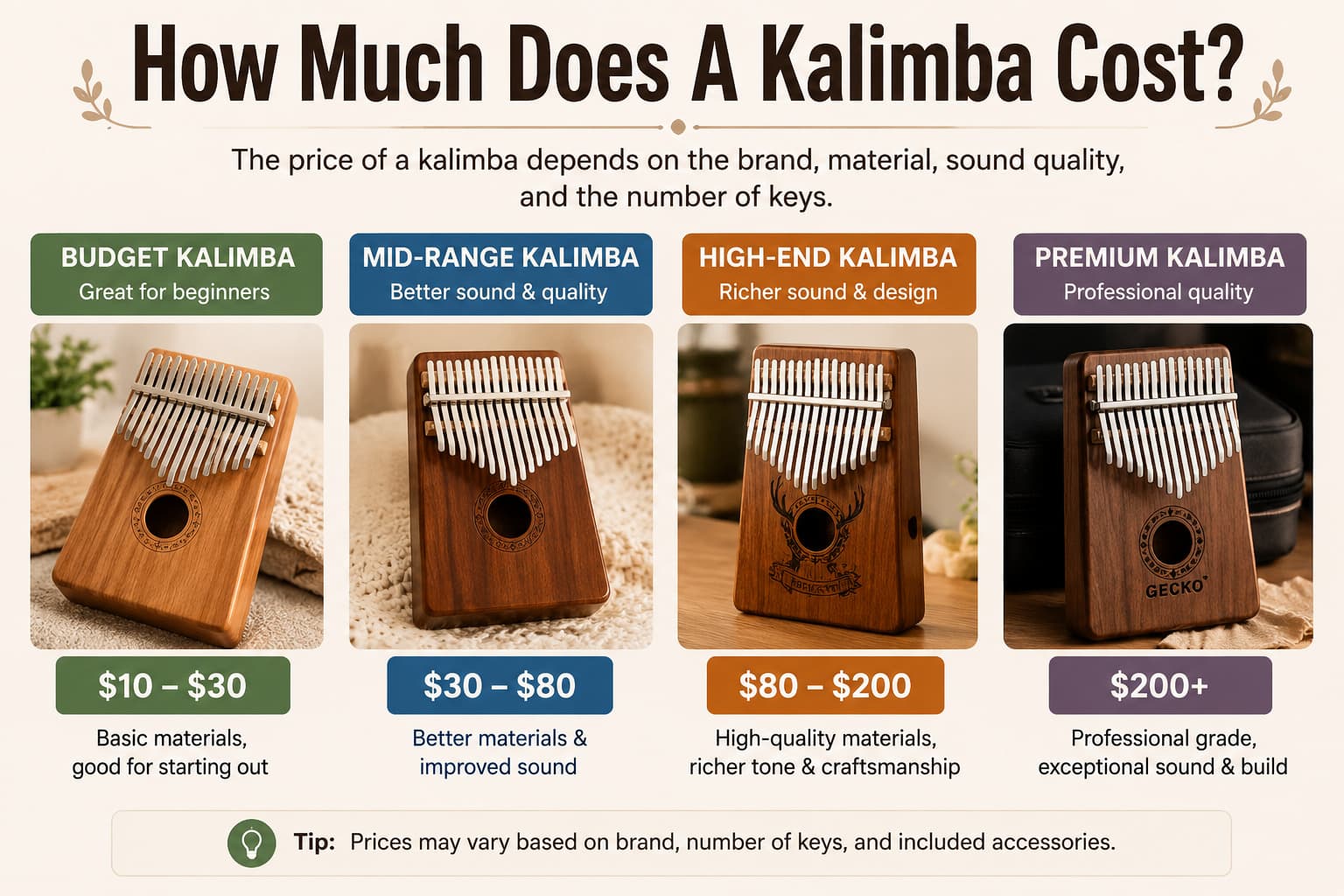
Kalimba is a popular timbre instrument that has a loosely varied African origin. Intrigued musicians can collect this one for sure. But that brings us to the question: how much does a kalimba cost in the US? Notably, the kalimba is not just a musical tool.
It’s musical properties make it distinct from other traditional timbre-based instruments. Now, coming to the price, you might have to spend around $20 for a good Kalimba in the USA. However, that is a beginners’ instrument which costs $20.
People who want it’s intermediate or advanced versions might have to pay $30 to approximately $80. But the variations does not end there. And that’s why we clarified at first that the kalimba is not just a musical tool you can buy and start playing.
To clarify, the more advanced levels of kalimbas cn cost upto $200. They are mostly made by hand and are highly customized and amplified as per theplayer’s skills and requirements.
Introduction To Kalimbas
A kalimba is a hand-held instrument with metal tines fixed to a wooden, acrylic, or composite body. You normally hold it in both hands and pluck the tines with your thumbs. Each tine produces a different pitch.
Although it is often called a “thumb piano,” it does not work exactly like a piano. The tines usually spread outward from the longest, lowest note in the center. This alternating layout helps the two thumbs share melodies and chords.
More importantly, a kalimba is not just a musical tool. It can be a portable songwriting companion, a gentle accompaniment for singing, a way to explore rhythm, or simply an enjoyable screen-free hobby.
The modern commercial kalimba has roots in African lamellophones. These are plucked instruments with tongues or tines attached to a sounding board or resonator.
A late-19th- or early-20th-century example in The Metropolitan Museum of Art uses wood, steel, and copper.
Its gourd resonator helps strengthen the sound. That history is worth recognizing:
“The modern kalimba is related to a large and culturally varied African instrument family, not one single, uniform design”
Understanding Kalimba Types
The right type matters more than the highest tine count. Start by asking one question:
“Do you want the easiest route into playing, or do you need every sharp and flat for more complex music?”
Diatonic Kalimbas
A diatonic kalimba contains the notes of one main scale. A 17-key model in C major is the familiar example. Think of it as having the white notes of a piano across a limited range.
This design is beginner-friendly because the available notes naturally work together. It also matches a large amount of beginner tablature and video instruction.
The trade-off is that some songs contain notes outside the kalimba’s scale. You may need to simplify those passages, retune one or more tines, or choose another instrument.
For a first purchase, a 17-key C-major model in the $30–$60 range is usually the safest choice.
Chromatic Kalimbas
A chromatic kalimba adds the sharps and flats missing from a diatonic model. Designs vary. Some place a second row of tines on the front. Others place extra tines on the back.
The latter requires the player to reach notes that may not be visible while playing.
According to Kalimba Magic’s chromatic playing guide, these added notes allow far more melodies, harmonies, and key changes.
However, they also make the instrument harder to learn. Chromatic kalimbas generally cost more because they have additional tines and require more detailed setup and tuning.
Choose one if you already understand basic scales, want to arrange complex songs, or do not want to keep switching between kalimbas in different keys.
Mini Kalimbas And Bass Kalimbas
Mini kalimbas commonly have five to ten tines. They are light, portable, and fun for short melodies. Current U.S. listings include small eight-note models near $20–$30.
Their limited range makes them better for casual use, travel, or gifts than for learning a broad song library.
Bass kalimbas sit at the other end. Their longer, lower-pitched tines and larger bodies produce deeper notes. They are less common, and the term “bass kalimba” is not standardized across brands.
Expect specialist models to cost more than a basic 17-key instrument. Check the exact lowest note and tuning rather than trusting the word “bass” in a listing.
Key Kalimba Materials And Construction
The body and tines shape the playing experience, but an expensive wood name does not automatically guarantee a better instrument.
- Hollow wooden body: A box with a sound hole can produce more volume and a resonant, lively tone. It may also sound uneven if the shortest, highest tines do not vibrate freely.
- Solid wooden board: Usually quieter but comfortable and consistent. Mahogany, acacia, maple, walnut, bamboo, and sapele are common.
- Acrylic body: Heavier than many wooden models and visually striking. The tone can be bright and clear, but comfort and weight deserve attention.
- Metal tines: Tine finish, smoothness, spacing, and tuning matter more than a decorative label. Rough edges or very stiff tines can make longer sessions uncomfortable.
- Pickup-equipped body: A built-in pickup lets you connect the kalimba to recording or amplification equipment. It raises the price but can be worthwhile for performers and creators.
For example, MEINL describes a solid black-walnut model with plated-steel tines.Meanwhile its package includes a case, tuning hammer, cloth, and storage bag.
This is a useful reminder to compare the complete build and package. Not wood species alone.
Popular Kalimba Brands And Models
Brand reputation can reduce uncertainty, especially when a maker publishes its tunings, materials, replacement options, and care guidance.
Still, judge the model as well as the logo. Even strong brands sell instruments with different note ranges and purposes.
Hugh Tracey Kalimbas
Hugh Tracey began producing his commercial kalimba design in South Africa in the 1950s. Today, original Hugh Tracey instruments are made by African Musical Instruments.
Their construction commonly uses African kiaat wood and spring-steel tines.
At the time of this review, specialist U.S. retailer Kalimba Magic listed Hugh Tracey models such as the Alto and Treble at about $140, with several pickup-equipped or specialized models around $150–$165. These are serious instruments rather than bargain starter toys.
Hugh Tracey is a sensible brand to explore if you value a long-established design, distinct tunings, repairability, and detailed learning material. Just confirm the tuning before ordering.
“Alto,” “Treble,” and “Chromatic” do not all share the standard 17-key C layout found in most beginner tutorials.
Other Notable Brands
- MEINL Sonic Energy: Widely available through U.S. music retailers. Its range includes mini, 10-note, 17-note, 21-note, sound-hole, solid-body, and pickup models.
- HOKEMA: A German maker known for solid-wood kalimbas and Sansula instruments. These often use fewer notes and special tunings, so they offer a different experience from a standard 17-key model.
- Gecko, LingTing, Hluru, and Seeds: Common names in beginner, intermediate, and chromatic shopping. Availability can vary by seller, so confirm the exact model, warranty, and return policy.
- Stagg, Mahalo, Luna, and LP: Brands currently represented in large U.S. music-store listings, with models covering different note counts and price levels.
Do not assume that a 21-key instrument is chromatic. Many simply extend the low range while remaining diatonic. Read the tuning chart before buying.
How Much Does A Kalimba Cost?
Here is a detailed analysis of what kind of Kalimba you get at what price range:
Price Range Overview
Prices below are practical U.S. shopping ranges, checked on September 4, 2026. They are not fixed retail prices.
| Approximate price | What you are likely to find | Best suited to |
|---|---|---|
| $15–$30 | Mini models, simple eight-note instruments, and occasional basic 17-key options | Travel, gifts, or testing your interest |
| $30–$60 | Many beginner 17-key models; some kits with a hammer, pouch, or case | Most first-time players |
| $60–$100 | Better-finished solid or hollow bodies, 21-key models, pickups, or fuller kits | Regular practice and recording experiments |
| $100–$200 | Premium brands, handmade construction, advanced tunings, chromatic or amplified models | Committed players and performers |
| $200+ | Specialist acoustic instruments, premium Sansulas, custom work, or electronic hybrids | Collectors and players with a defined need |
For a real-world snapshot, Guitar Center’s U.S. listings showed:
- An eight-note mini at $19.99
- Several 17-key instruments between $29 and $79.99
- A 21-note model at $99.99
- Pickup-equipped models reaching $149.99.
Those examples support the ranges above, but sales, shipping, and stock can change the checkout total.
Quick answer: If you are still wondering how much does a kalimba cost for a beginner, set aside $30–$60. That budget is usually enough for a playable 17-key model without paying for specialist features you may not use.
Factors Influencing Price
The key cost drivers are:
- Number and layout of tines: More tines add material, tuning work, and musical range.
- Tuning system: Chromatic and unusual tunings can cost more than a mass-market C-major layout.
- Construction quality: A flat bridge, secure hardware, smooth tines, and careful finishing affect comfort and sustain.
- Body design: Solid boards, hollow resonators, acrylic bodies, and membrane-mounted designs sound and cost differently.
- Handcrafting and quality control: Individual voicing and tuning add labor.
- Electronics: A pickup, output jack, tone controls, or other electronic features increase the price.
- Import and seller costs: Shipping, duties, location, and return support can change the final U.S. price.
Package Deals And Accessories
A $45 kit may be better value than a $35 bare instrument. Check whether the box includes:
- A tuning hammer
- A padded bag or hard case
- A cleaning cloth
- Note stickers
- A printed tuning chart or beginner guide
- A pickup cable, if the instrument has electronics
Only count accessories you will use. Note stickers and a guide may be helpful on day one, while a protective case adds long-term value. A cheaply made decorative pouch should not decide the purchase.
Where To Buy A Kalimba In The United States
You have four practical routes:
- Large music retailers: Guitar Centre and similar stores offer clear return terms and may let you compare models in person. Local stock can be limited.
- Specialist kalimba stores: Retailers such as Kalimba Magic carry Hugh Tracey, HOKEMA, alternative tunings, books, and parts. They are useful when you need informed model guidance.
- Brand or authorized-dealer websites: A good route for checking specifications and finding legitimate sellers.
- Large marketplaces: Convenient, but quality can vary between sellers. Check who fulfills the order, whether the product is new, and how returns work.
Before paying, calculate instrument + shipping + tax + any case or tuner you still need. That total is the honest answer to how much does a kalimba costs for you.
Getting Started With Your Kalimba
When the instrument arrives, do not start by changing every tine. First, check the package for damage. Then compare each note with a tuning app in a quiet room.
A new kalimba may need a small correction after shipping, but large adjustments should not be normal.
Start with the center tine, then alternate left and right. Learn a five-note pattern before attempting a complete song. Number-based kalimba tablature can help because each printed number corresponds to a tine.
Try this first-session plan:
- Play each note slowly and listen for a clean ring.
- Practice alternating thumbs for five minutes.
- Learn one short phrase rather than an entire song.
- Repeat it at a steady speed.
- Record yourself once; listening back reveals uneven timing.
Essential Kalimba Accessories
You do not need a bag full of equipment. A practical setup includes a tuning hammer, chromatic tuner or reliable tuning app, protective case, and the correct cleaning cloth for your model.
Players who record may also want a pickup-equipped kalimba, suitable cable, audio interface, or microphone. Buy those only after deciding how you plan to record. For casual home practice, the instrument, hammer, and case are enough.
Tuning And Maintenance Tips
Tuning changes the vibrating length of a tine. As a general rule, moving a tine so that its free end becomes shorter raises its pitch; lengthening the vibrating section lowers it.
Make tiny adjustments with the hammer, check the tuner again, and stop once the note is correct.
Do not strike hard or attempt a major retuning without a model-specific chart. On a chromatic instrument, the relationship between front and rear tines can make a full key change more involved.
After playing, remove visible moisture and fingerprints. Follow the maker’s instructions because finishes differ.
For example, HOKEMA advises using a dry cotton cloth on its coated reeds and warns that moisture and unsuitable cloths can damage the coating over time.
Playing The Kalimba In Different Music Genres
The kalimba is not limited to lullabies or meditation tracks. Its clear attack works well in pop, folk, gospel, film music, ambient arrangements, and selected hip-hop or R&B melodies.
A chromatic model offers more freedom for jazz, classical pieces, and songs with frequent key changes.
For listening and melody ideas, explore Gossipment’s collections of Udit Narayan songs, Alka Yagnik songs, and Kumar Sanu songs.
Many vocal hooks discussed in these articles can inspire simplified single-note practice. However, check whether an arrangement fits your kalimba’s tuning before expecting every note to be available.
If Western pop is closer to your taste, browse the site’s selections of the ‘best singers’ and ‘hollywood singers’. Use them as a listening list: choose one clear melody, find its key, and test a short phrase by ear.
Tips For Choosing The Right Kalimba
Use this quick decision check:
- New player who wants the most tutorials? Choose a 17-key C-major diatonic kalimba.
- Small hands or frequent travel? Try a compact solid-board model, but confirm that you can comfortably reach the outer tines.
- Complex arrangements or several keys? Consider a chromatic model.
- Want to perform or record directly? Look for a built-in pickup and a standard output connection.
- Buying for a child? Check tine edges, instrument weight, age guidance, and small removable parts.
- Still unsure? Choose comfort and clear tuning over decoration or the largest tine count.
If possible, listen to an unedited sound sample through headphones. Pay special attention to the shortest tines. A pretty body cannot compensate for high notes that sound dull or fail to ring.
Reading Reviews And Ratings
Star averages are only a starting point. Search reviews for repeated comments about:
- Dead or quiet high tones
- Buzzing notes
- Sharp tine edges
- Tuning after several weeks
- Cracks, loose bridges, or damaged cases
- Seller support and return handling
Give more weight to detailed reviews that name the exact model and explain how long the buyer used it. Ignore complaints about a feature the product never promised.
Also watch for reviews combined across several models, colors, or key counts.
Comparing Online And In-Store Buying Experiences
Online shopping provides more brands, tunings, and price comparisons. You can also study demonstrations before buying. Its weakness is simple: you cannot feel the tine resistance or hear that individual instrument before it arrives.
In-store shopping lets you test comfort, weight, volume, and note consistency. Ask permission to play every tine and compare at least two models. The downside is a smaller selection, especially for chromatic and Hugh Tracey instruments.
Whichever route you take, confirm the return window before purchase. That matters more than saving a few dollars on an instrument you cannot comfortably play.
How to Care For Your Kalimba
Store the kalimba in its case in a dry, stable indoor environment. Keep it away from rain, steamy rooms, hot cars, and long exposure to direct sunlight.
Moisture can affect the metal tines and wood, while sudden temperature or humidity changes may stress the body.
Wash and dry your hands before playing. Wipe the instrument afterward with the cloth recommended by its maker.
Do not apply household cleaner, alcohol, or oil unless the manufacturer specifically approves it for that surface.
Check tuning periodically rather than obsessively. If a tine starts buzzing, inspect it for dirt or poor seating before forcing it sideways.
When the body cracks, hardware loosens, or electronics fail, contact the seller or a qualified repairer.
How To Improve Your Kalimba Skills
Short, regular sessions beat an exhausting practice marathon. Ten to fifteen focused minutes can include rhythm, a difficult phrase, and one enjoyable song.
Build skill in this order:
- Clean single notes
- Alternating thumbs
- Even rhythm with a metronome
- Simple two-note chords
- Melody and accompaniment together
- Playing by ear
- Arranging or improvising
Keep the difficulty gradual. Gossipment’s lists of Abhijeet Bhattacharya songs can give Bollywood listeners more melodies to investigate.
On the other hand, coverage such as the Eminem tour can prompt hip-hop fans to experiment with recognizable hooks and rhythmic patterns.
You are not looking for ready-made kalimba tabs in those articles. I would rather suggest building a personal listening list and training your ear.
Once a week, record the same 30-second passage. Compare timing, unwanted buzzes, pauses, and note clarity. Simply put, that simple habit gives you evidence of progress.
Choosing A Kalimba: More Than Assessing The Price
So, how much does a kalimba cost? Remember, a kalimba is not just a musical tool. That’s why most U.S. beginners should expect to spend $30–$60 for a useful 17-key instrument. Some are even eager to pay as far as $100.
Small models may start near $20, while better-finished, 21-key, pickup-equipped, chromatic, handcrafted, and specialist models can run from $60 to well above $200.
Do not choose by price alone. Instead, match the tuning to the songs you want to play, check whether your hands can reach the tines, listen for clear high notes, and compare the complete package.
To conclude, the best first kalimba is not the fanciest one. Rather, it is the instrument that feels comfortable, stays in tune, and makes you want to pick it up again tomorrow.